NLWC News


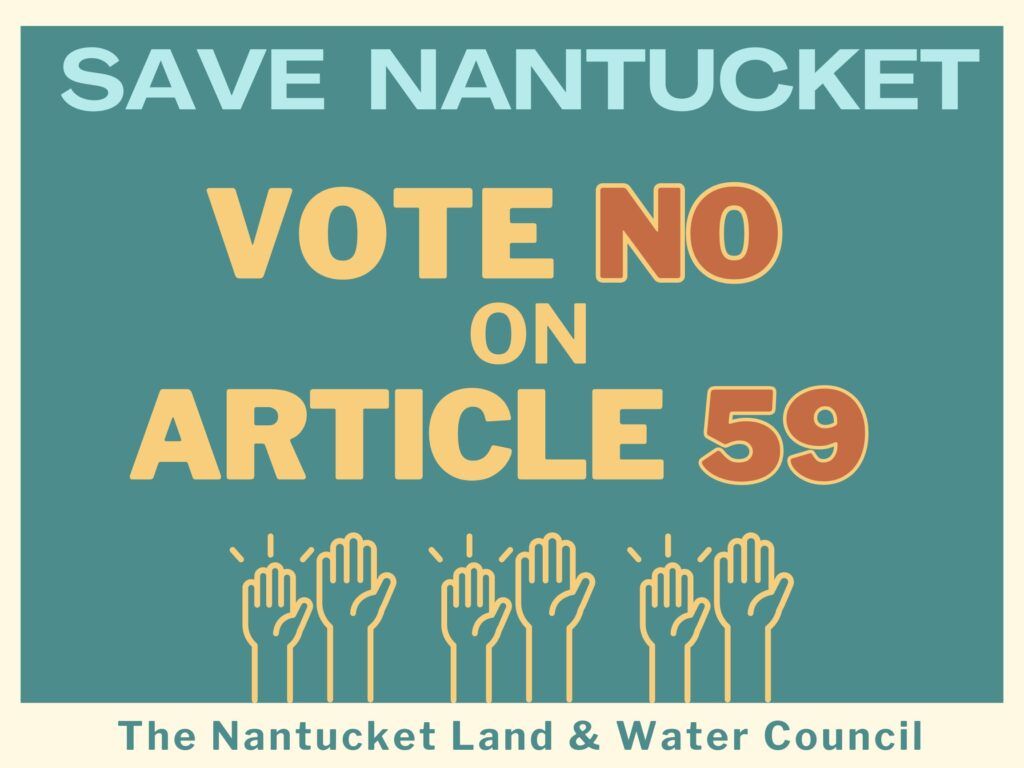
Vote NO on Article 59

Anna Day • May 20, 2024

The NLWC has observed that the rise of the commercial short-term rental (STR) industry contributes to and incentivizes an intense (re)development of properties on Nantucket designed to deliver the highest rate of return. This is often accomplished by maximizing properties with buildings, bedrooms and amenities intended to meet the expectations of prospective occupants. This decreases open space and habitat in neighborhoods, escalates the intensity of use, and puts increasing pressure on the island’s resources jeopardizing the health of our drinking water, ponds and harbors, and our shared infrastructure such as solid waste and storm-water management, water and sewer.


Article 59 is identical to the previously-defeated Article 42 at the 2022 ATM and Article 2 at the 2023 STM. This article MUST BE DEFEATED because it would legalize unlimited commercial STRs as a primary use for houses in all our residential districts across the island. If this right is granted under zoning it cannot be taken away and could open up the floodgates for STR investment. Allowing commercial STRs in residential districts would have long-term adverse, and potentially irreversible impacts on our environment and the health of our community. Moreover, recent court rulings have confirmed that STRs are a commercial use that is not legal in residential districts.


NLWC supports allowing STRs as an accessory use in residential districts protecting residents’ ability to rent their homes so long as they are using it primarily as a residence. NLWC would support balanced By-Law proposals that reasonably limit STRs to Nantucket residents, ensure effective regulation by our Town government, and are consistent with our local traditions. NLWC opposes STRs for commercial or investment purposes.


The commercial short-term rental industry, if unchecked, threatens to irreparably harm our Island’s environment and therefore our community’s vitality, health and quality of life. Obviously, this is an outcome that we all want to prevent.


If maintaining a healthy environment, community and quality of life on Nantucketis important to you, please attend Town Meeting and vote a resounding NO on Article 59.

February 4, 2026
If you feel aligned with our mission and would like to support our work through advocacy, there are many meaningful ways to get involved. You can attend local regulatory meetings, participate in and speak at Annual Town Meetings, serve as an informed environmental ambassador among friends and neighbors, rally support for articles that protect Nantucket’s natural resources, and oppose those that pose risks to their long-term health. You can also lend your voice by drafting or signing Letters to the Editor. If you’re interested in participating in our advocacy efforts as a Community Advocate, please click H ERE.
December 22, 2025
As the end of the Fall season approaches, we would like to take some time to reflect on Nantucket’s recent Special Town Meeting, held on November 4th. The Nantucket Land & Water Council has been engaged in Nantucket’s discussion about short-term rental (STR) policy and regulation for many years. As an organization, we have, at times, faced questions from residents about the relevance of STRs to the NLWC’s mission . The NLWC’s mission is to help preserve the long-term health of Nantucket’s environment and community through the protection of our land and water resources. Development impacts the environment. This simple fact should come as no surprise. Our actions on the land have a direct impact on the health of our waters. Nutrients like nitrogen and phosphorus from septic systems and fertilizers, along with other contaminants such as those found in stormwater runoff, don’t just disappear. They travel through the soil and into our ponds, harbors, and drinking water. The accelerated development, repurposing of properties, and intensity of use associated with short-term rentals (STRs) as a business put increasing pressure on the island’s infrastructure, reduce habitat and biodiversity, and endanger our water quality. Of course, a community needs to change and develop and grow, but the health of our environment and the ability of a place to naturally support the people who live there are directly related to the intensity and type of development and growth that we, as a community, choose to allow and encourage. The NLWC has always made it clear that we are not opposed to all short-term rentals. We support the ability of island residents to short-term rent with reasonable restrictions. We have, first and foremost, sought to reduce the impact from investor-owned STRs, and reduce the intensity of use and development from properties that are maximized solely for the use of short-term rentals because of the cumulative environmental impacts that this type of use and development creates. We were very disappointed by the November STM vote, which resulted in the full codification of short-term rentals across all residential zoning districts of the island. It is clear that much of the community was incredibly alarmed by the simple messaging provided by Article 1 proponents that asserted this was a matter of maintaining an important property right or losing that right. Alternatively, we, as proponents of Article 2, attempted to communicate a more nuanced message that memorializing this right with reasonable restrictions would actually allow most residents to continue short-term renting in a meaningful way while helping to protect the future of our environment and community. As the dust settles, and our media expresses the reality of the inadequacy of our existing regulations ( https://nantucketcurrent.com/news/nantucket-banned-corporate-owned-short-term-rentals-a-loophole-is-allowing-them-to-continue ) , there is clearly more that needs to be done. All of our policies and practices relative to growth, development, and land and resource management , including STR regulations, must be scrutinized for their impact on our shared natural resources and adjusted where needed to protect the health of our environment and community. It is easy to make the claim that STRs as an issue is not “in our lane” and to suggest that how we use and develop our properties are somehow separate from: PFAS issues, contamination of our public water supply, nutrient pollution, and water conservation , but these are the exact concerns that compel the NLWC to engage in community conversations about growth, development, land use, and STRs. We are the voice for Nantucket’s environment, working to safeguard the present health and future sustainability of the island. This is our lane. We thank all of our members and friends for your support , regardless of your position or vote at STM. We know that, despite differences in opinion, we all share a deep care for this special place and a desire to protect what makes it unique. Together, we can shape policies that reflect both the needs of our community and the limits of our fragile island environment. Your willingness to stay engaged—ask questions, share concerns, and offer ideas—continues to strengthen our efforts. There is more work to do, and we look forward to doing that work with you.
By Anna Day October 27, 2025
At the upcoming Special Town Meeting on November 4th, Nantucket voters will once again consider how best to regulate short-term rentals (STRs). After years of debate, two competing proposals, Articles 1 and 2, offer very different paths forward. The Nantucket Land & Water Council (NLWC) supports Article 2 , which encourages sustainable use of island resources and provides a balanced, long-term solution. Click Here to read the NLWC’s recommendations on the warrant articles. Click Here to read our Letter to the Editor. Join Us and Vote Environment First! Tuesday, November 4 at 5:00 pm in the Mary P. Walker Auditorium of the Nantucket High School.
MORE NEWS