NLWC News
MassDEP Casts Doubt on 'Sconset Beach Geotube Expansion
On August 31st,
the Massachusetts Department of Environmental Protection
(DEP) issued a letter rebuking the efforts of Siasconset Beach Preservation Fund
(SBPF) to expand the geotube project on Sconset Beach. Nantucket Land & Water Council (NLWC) along with over a dozen Nantucket residents, including members of the Nantucket Coastal Conservancy (collectively “Appellants”), appealed the Conservation Commission’s March 2025 approval of an Order of Conditions for the geotube expansion.
Now seventeen months later, DEP’s letter dated August 31, 2026,
casts grave doubt on whether the expansion project will be approved by the state agency. This setback follows the denial of a license for the project at Town Meeting last spring.
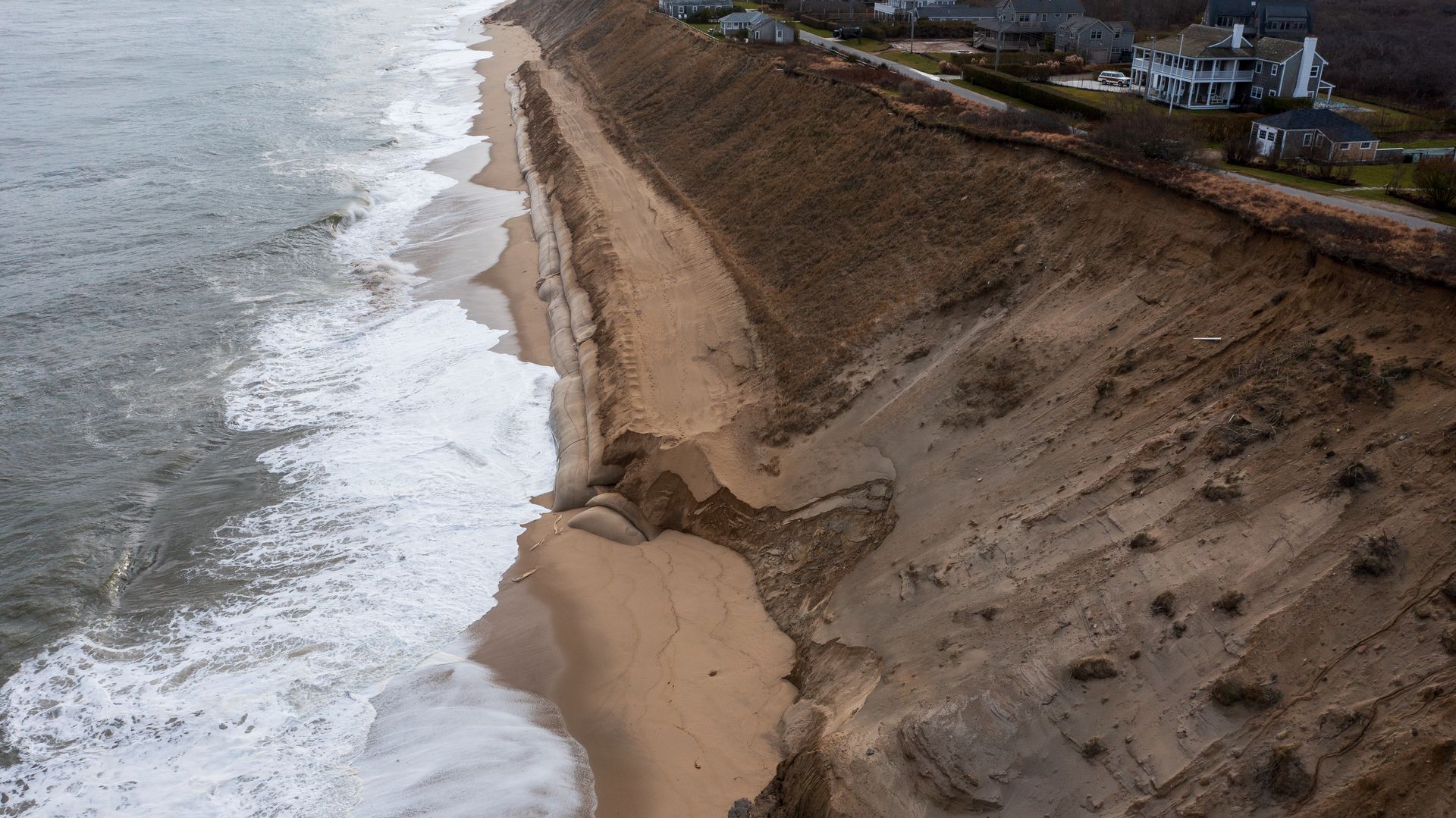
Siasconset geotubes aerial image
DEP’s letter highlights a dozen major issues with the project that remain unresolved because SBPF has failed to provide critical information to show the project meets regulatory standards. The letter states: “There remain a number of issues where additional information is required or where you did not provide sufficient response to our inquiries.” (8/31/26 DEP Ltr. p. 1)
Among this missing data and documents requested by DEP that have not been provided by SBPF is a litany of key information needed to fully evaluate the proposed project and its impacts:
- Detailed construction plans stamped by a registered professional engineer
- Delineation of Coastal Bank and Coastal Dune by qualified professional
- Remove any proposed geotubes or coastal engineering structure from Coastal Dunes
- Evaluation of resource area impacts from compaction during construction access
- Demonstrate “how this work can be done above MHWL [mean high water level] given the limited area above the MHWL.” (Id. p. 3)
- Provide missing monitoring data from the existing geotubes (which has not been provided from June 2022 to the present) to verify whether the beach in front has narrowed by 45 feet since they were installed
- “The Applicant failed to provide an alternatives analysis that satisfies the minimum regulatory requirements.” (Id. p. 4)
- “The Department requests a sediment transport study. . . . No study was provided.” (Id.)
- Clarify SBPF’s obligations under existing permits and Certificates of Compliance
- Reevaluate the calculation of total resource area impacts, which must include the replacement of existing permitted coir logs in different configurations or larger footprints.
Finally, DEP credited NLWC’s and Appellants’ position, which SBPF failed to refute:
“The Department requested that the Applicant [SBPF] address the information/concerns submitted by the Appellants, who provided a significant number of comments and supporting data. . . . No data or other supporting information or detailed analysis of Appellant's conclusion was provided to support the Applicant’s position that Appellant’s data or conclusions were wrong.” (8/31/26 DEP Ltr. p. 5)
The Appellants appreciate DEP’s careful review of the materials and thoughtful evaluation of this complex project: “The Appellants are organized, represented by counsel, and have submitted comments and data in support of their position”, according to DEP’s letter. (Id. p. 1)
Read the full letter from the Massachusetts Department of Environmental Protection
In response to the DEP letter, Emily Molden, NLWC’s Executive Director, said: “This letter from DEP, after a year and a half of review, validates many of the concerns we have been raising throughout the permitting and local approval process for this expansion project. A massive volume of mitigation sand – over a hundred thousand cubic yards – still remains to be put on the beach from their prior permit, which has negatively impacted our publicly owned coastal resource areas. After Town Meeting denied a license for the project and now that DEP has echoed our concerns about the insufficiency of information to assess resource area impacts or whether the project can even be constructed as proposed, it is time to reevaluate how we collectively approach coastal management of this shoreline.”
Instead of furthering SBPF’s efforts with expanding the geotubes, which have not been successful at mitigating impacts to our coastal systems or adjacent properties,
NLWC advocates that the Town should continue to proceed with securing funding and easements for the Baxter Road Alternative Access Plan, which has been fully designed and permitted. “Instead of continuing to fight an unwinnable battle against the Atlantic Ocean, using methods that have not been successful,” said Molden, “ it is time for us to work together on the only viable long-term strategy -- retreat that can be readily accomplished through construction of the Alternative Access Plan.”
Media Contact:
Emily Molden
Executive Director
Nantucket Land & Water Council
emily@nantucketlandwater.org | 508-228-2818